
What Designers Should Know Before Backlighting Stone
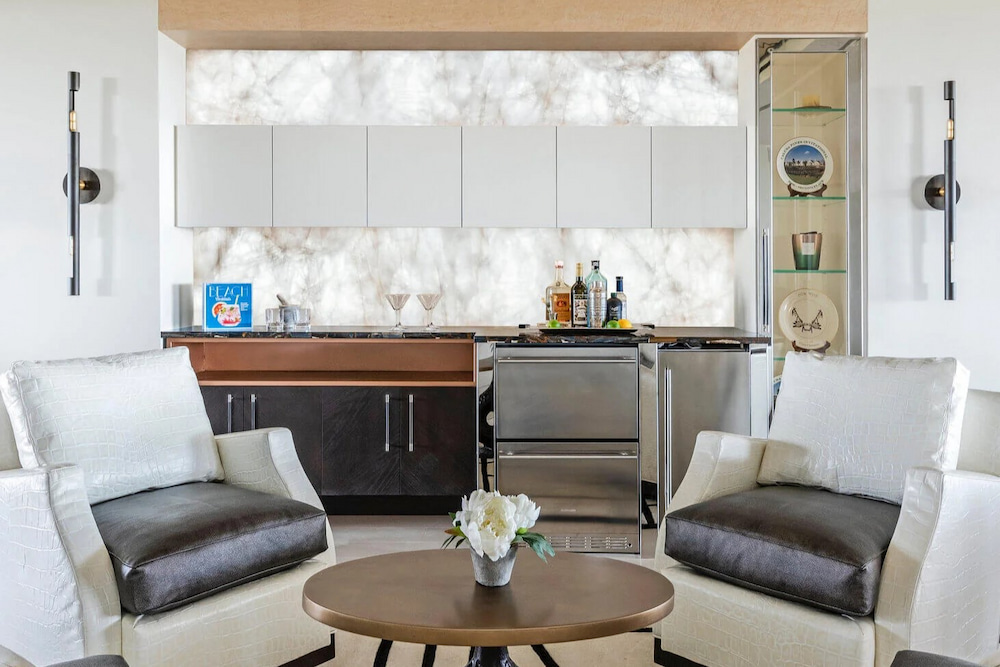
Not every countertop or shower wall was born to glow. But pair the right stone with the right light, and a surface that once sat quietly in the background can suddenly steal the scene. Onyx islands seem to smolder with warmth. Marble panels hold onto daylight long after the sun disappears. Veins, fissures, and crystalline structures that were barely noticeable suddenly come alive.
The finished effect can look almost effortless. Getting there is anything but. Material choice, wiring, structural support, diffusion, and timing all have to line up before a single light goes on. That’s exactly the kind of groundwork our backlit stone surface designers walk clients through on every project.
In this blog, we’re breaking down what actually goes into planning a backlit stone feature, so keep reading to learn more!
What makes stone suitable for backlighting?
The single biggest factor is translucency, not color, cost, or how spectacular the slab looks leaning against the wall at the stone yard. A slab needs to let light travel through it with enough consistency to create illumination rather than a patchwork of bright and dark.
That’s where things get interesting. The same material can become an entirely different visual creature once light enters the picture. Veining and mineral density that read as decoration in daylight suddenly become part of the lighting composition after dark. Light finds pathways through the stone, revealing depth, texture, and patterns that were hiding in plain sight. It’s part of what turns a plain surface into a statement, because you’re no longer simply looking at the stone; you’re seeing light move through it.
Which stones work best
A handful of natural stones show up again and again in illuminated interiors:
- Onyx: Prized for rich veining and dramatic color shifts once backlit
- Alabaster: A soft, even glow with a warm, paper-like translucency
- Certain marbles: Translucency varies by slab, so each piece needs testing
- Quartzite and agate: Dense veining that creates high-contrast patterns
- Cristallo: A crystalline quartz known for exceptional clarity under light
Man-made materials like resin or glass can mimic the look for less, though they won’t carry quite the same geological fingerprints. Natural stone has variation built into its DNA, which is part of both its beauty and its challenge.
Where placement comes into play
Where the material goes matters just as much as what it’s made of. A beautiful glow in the wrong location is still the wrong location. Kitchen islands and backsplashes are common starting points, but bathrooms, staircases, bars, fireplace surrounds, and architectural panels can all become spectacular candidates.
Homeowners exploring where luxury homes put backlit stone often discover that the most functional surfaces can become the most memorable ones, like a shower wall that glows gently at dusk, a bar front that becomes a luminous centerpiece, or a floating stair tread that seems to hover rather than simply sit. The goal isn’t to make everything glow. It’s to make the right thing glow.
What should be planned before backlit stone is installed?
Backlit stone needs more upfront choreography than a standard stone installation because the lighting isn’t decoration added afterward; it’s part of the assembly itself. Stone, structure, electricity, and light all have to learn the same dance before installation day.
A few early decisions determine whether the finished surface reads as one beautiful field of illumination, or a very expensive collection of bright spots and shadows.
Sequencing the installation correctly
Backlighting isn’t something you casually tuck behind the stone after it’s set. The lighting system goes in first, secured beneath or behind where the slab will sit, and the stone is installed only after everything has been tested, adjusted, and confirmed.
That order matters. Once a large slab of stone is cemented into place, changing the lighting behind it moves quickly from “adjustment” to “demolition.” Testing before installation is considerably less dramatic, and considerably less expensive.
Placing LEDs for even light, not hot spots
LED placement and spacing determine whether the finished feature glows or merely reveals where somebody put the LEDs. Get it wrong, and you end up with bright dots, stripes, or shadows telegraphing through the stone instead of a soft, seemingly source-less wash of light.
Every project needs a plan for avoiding hot spots and uneven glow, which usually comes down to LED spacing, diffusion panels, cavity depth, and matching the light source to the thickness and translucency of the slab. The best backlighting almost makes the lighting itself disappear. You see the stone come alive without immediately seeing the machinery behind the magic.
Planning for heat, moisture, and access
Heat is another thing to plan for, especially in enclosed spaces like showers or built-in cabinetry. LEDs run cool compared to older light sources, but “cool” doesn’t mean “no heat.” Drivers, LED modules, and strips still need appropriate thermal management if they’re expected to perform reliably over time. Understanding how LEDs generate and manage heat helps explain why proper ventilation and heat dissipation behind the stone can extend the life of the whole installation.
A few other details are worth locking down before installation day:
- Access points for future repairs, since even hidden lighting occasionally needs service
- Waterproofing and sealing in wet areas like showers or tub surrounds
- Circuit capacity, so the lighting doesn’t strain the electrical system
- Slab thickness, confirmed with the fabricator before cutting begins
None of these details is particularly glamorous. Neither is tearing out a beautiful slab because somebody forgot about a driver. A little planning behind the scenes keeps the drama where it belongs: on the finished surface.
Why does the design team need to coordinate early?
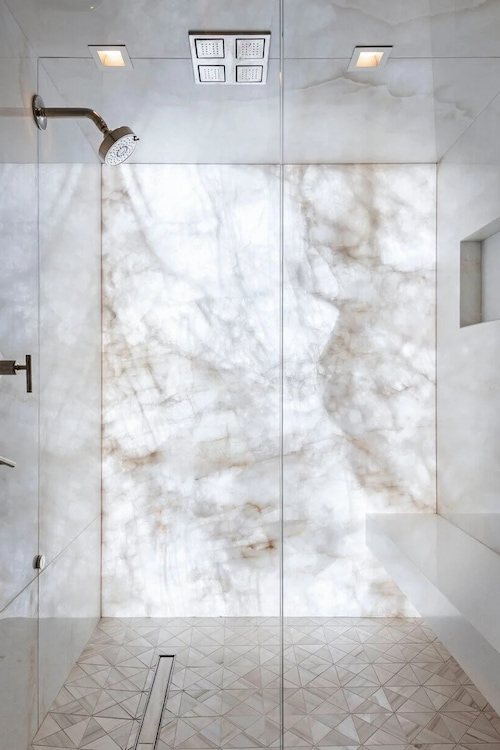
A backlit stone feature may look like one seamless object when it’s finished, but getting there requires a surprisingly crowded cast of characters. Lighting designer, stone fabricator, electrician, architect, interior designer, millworker, and installer may all touch some part of the final result.
The trick is making sure they’re all building the same result.
Each trade needs the same information
Stone fabricators need exact dimensions and cutout locations before they cut the slab. Electricians need to know where wiring, drivers, and power supplies will live before walls close up. Architects and interior designers need the final assembly understood before surrounding finishes and structural conditions are finalized.
When one trade works from yesterday’s drawing while another is building from today’s revision, those little differences have a habit of introducing themselves on installation day, usually with an invoice attached.
Successful illuminated stone isn’t simply a lighting detail or a stone detail. It’s a coordination detail.
Early coordination protects the timeline
Bringing everyone in early also protects the timeline. Lighting needs to be installed, tested, adjusted, and approved before the stone goes on top of it, so delays upstream ripple quickly downstream.
Projects that bring the lighting designer, architect, electrician, and fabricator together early tend to move more smoothly because the important questions are asked while they’re still inexpensive questions. Once the slab arrives, those same questions become very expensive answers.
That’s the real advantage of early coordination: fewer surprises hiding behind the stone.
Where can I find trusted backlit stone surface designers near me in Fort Myers, Naples & the area?
If you’re picturing a backlit stone feature in your own home, we’d love to help you figure out not only if it can glow, but how it should glow. Our team at Illuminated Lighting Design has spent years bringing these ideas to life across Naples and Fort Myers, backed by IALD membership and decades of combined lighting experience.
We’ve helped homeowners illuminate everything from onyx kitchen islands to full backlit shower walls, and we bring that same hands-on, sleeves-rolled-up approach to every new project. Near Naples Station, we’ll sit down with you, your fabricator, your architect, and the rest of the design team early enough to solve the puzzle before the pieces are permanently attached.
Because great backlit stone shouldn’t simply be a slab with LEDs hiding behind it. It should feel like the light was somehow waiting inside the stone all along.
Tell us about your project, and let’s figure out together what it takes to make it glow.